THE MOST IMPORTANT MENTAL HEALTH ASSET IN THE FIREHOUSE ISN'T A PROGRAM. IT'S A TABLE.
We have built apps for first responder mental health. Hotlines. Employee assistance programs. Awareness campaigns with hashtags and branded graphics. We have sent clinicians into firehouses and scheduled mandatory wellness check-ins and printed pocket cards with crisis numbers.
And first responders are still dying by suicide at rates higher than in the line of duty.
Not because the programs are wrong. Because most of them are solving the wrong problem.
The barrier to first responder mental health care was never a lack of resources on a shelf. It was always a lack of trust. And trust in the firehouse doesn't live in a program. It lives at the kitchen table.
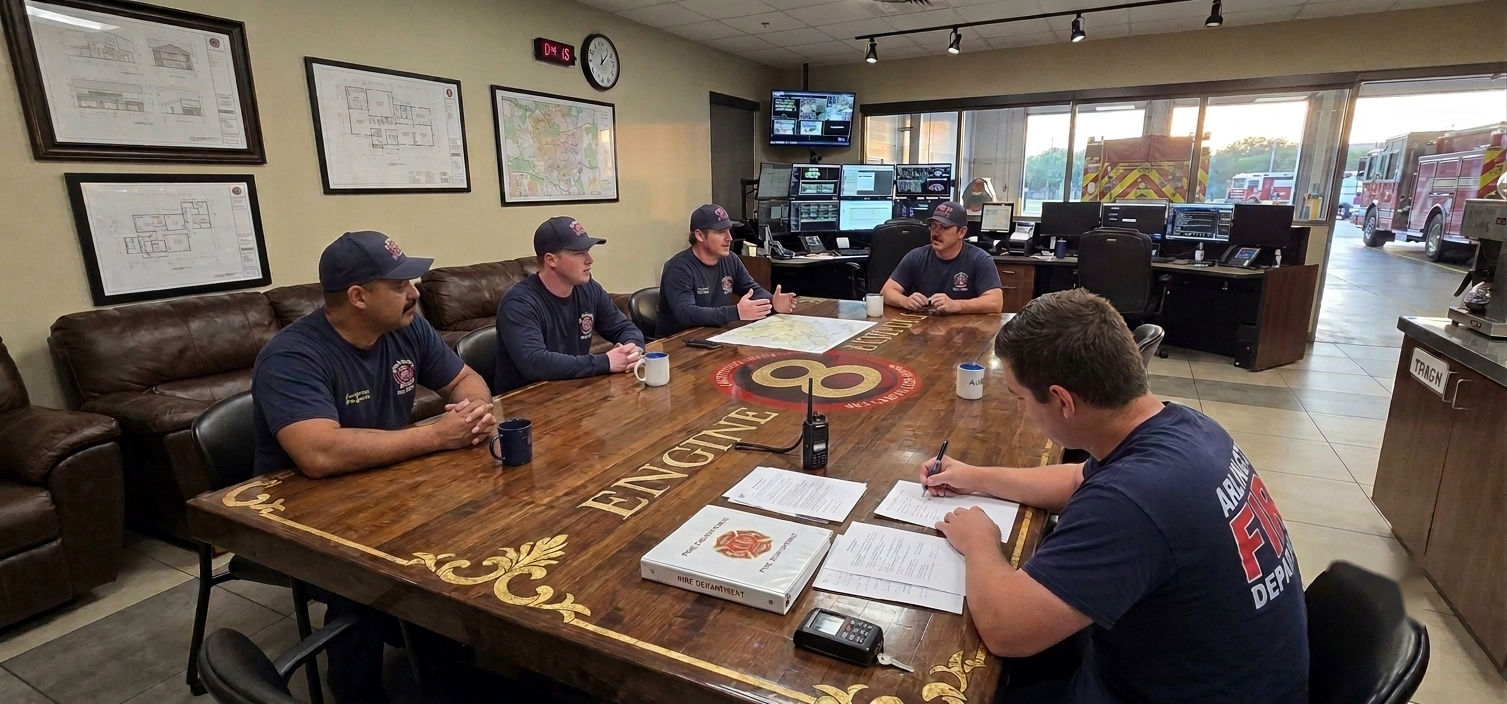
What the Kitchen Table Actually Is
Every firehouse has one. It's where the shift begins and ends. Where meals are cooked and eaten together. Where the job gets processed — not in clinical language, not in formal debriefs, but in the way people who've been through something together actually talk about it.
Dark humor. Half-sentences. Someone asking "you good?" and meaning something completely different than the words suggest. Someone else answering "yeah" and both of them knowing it might not be true — and knowing that the question will get asked again tomorrow, and the day after that.
This is not informal. This is not a workaround. This is the most sophisticated mental health infrastructure the first responder community has ever built — and it was built long before anyone used the phrase "mental health infrastructure."
The kitchen table is where trust compounds. Where colleagues become people who would notice if something was wrong. Where the culture of "we take care of our own" gets practiced, not just stated.
And it is exactly what most formal mental health programs bypass entirely.
Why Formal Programs Fail When Trust Hasn't Been Built
Here is what happens when a mental health program arrives in a firehouse that hasn't been prepared for it.
The clinician is credentialed but unknown. The program is evidence-based but culturally foreign. The first responder sitting across from a stranger is doing a rapid threat assessment — not of the clinician, but of the situation. What gets reported. What reaches a supervisor. What happens to a career if this conversation goes the wrong way.
In a culture built on trust earned over years, a program that arrives without it doesn't get used. It gets tolerated — checked off, signed, filed.
This is not resistance to help. This is a reasonable response to an unreasonable ask: that someone whose identity is built on toughness and whose career depends on being deemed fit for duty should open up to a stranger in an institutional setting with unclear confidentiality protections.
The programs that work — the ones with actual utilization rates, actual help-seeking behavior, actual impact on the numbers — are the ones built on top of existing trust. Peer support programs staffed by trained first responders who already have a seat at the kitchen table. People whose credibility comes not from a credential on a wall but from having worked the same calls, carried the same weight, and shown up the next day anyway.
Trust Is the Mechanism. Peer Support Is the Delivery System.
Research on first responder mental health is consistent on this point: culturally competent interventions outperform clinical-only approaches in populations where trust is the primary barrier. In male-dominated workforces with strong occupational identity — which describes virtually every first responder community in the country — peer-led outreach increases help-seeking behavior in ways that external programs simply don't replicate.
This isn't a soft finding. It's a utilization finding. Programs that first responders actually use are programs delivered by people they already trust.
Which means the kitchen table isn't just a metaphor. It's a distribution network.
When a trained peer supporter has an established presence at that table — when they're known, when they've worked alongside the people they're supporting, when they've earned the right to ask "you good?" and get a real answer — the activation energy required to seek help drops dramatically.
That's the mechanism. Fund the mechanism.
What It Costs to Let the Table Go Dark
Here is what happens when peer support programs are underfunded, understaffed, or allowed to collapse.
The trained peer supporters burn out or move on. The relationships they built don't transfer — trust is not institutional, it's personal. The next person who sits down at that table is a stranger again. And the whole process of earning credibility starts over from zero.
In a culture where trust takes years to build and seconds to lose, this is not a minor setback. It is a systemic failure with a body count.
Nearly 47% of firefighters report experiencing suicidal ideation at some point in their career. Law enforcement officers face a suicide risk 54% higher than the general population. These numbers don't move because a program existed for two years and lost its funding. They move because of programs that have been there long enough to become part of the culture — long enough that asking for help feels like something the culture permits, not something it punishes.
That kind of permanence requires sustained investment. Not a grant cycle. Not a one-year sponsorship. A multi-year commitment to the people and the programs that have earned a seat at the table.
The Investment the Kitchen Table Needs
Funding peer support infrastructure is not complicated. It is just not glamorous enough to attract the attention it deserves.
It looks like paying trained peer supporters for their time instead of relying entirely on volunteers who are already carrying a full operational load. It looks like providing clinical supervision so peer supporters have somewhere to take what they absorb. It looks like funding the continuity — the years of presence that turn a program into a fixture, and a fixture into trust.
It looks like treating the kitchen table as the infrastructure it actually is.
Because the most effective mental health intervention in the first responder community has been sitting in every firehouse for a hundred years. It just needs to be funded like it matters.
Invest in what already works at investinfirstresponders.com
Invest in First Responders (IIFR) connects corporate capital and foundation funding with trusted, peer-led organizations on the frontlines. We fund the infrastructure that first responder communities already trust — and help it last.